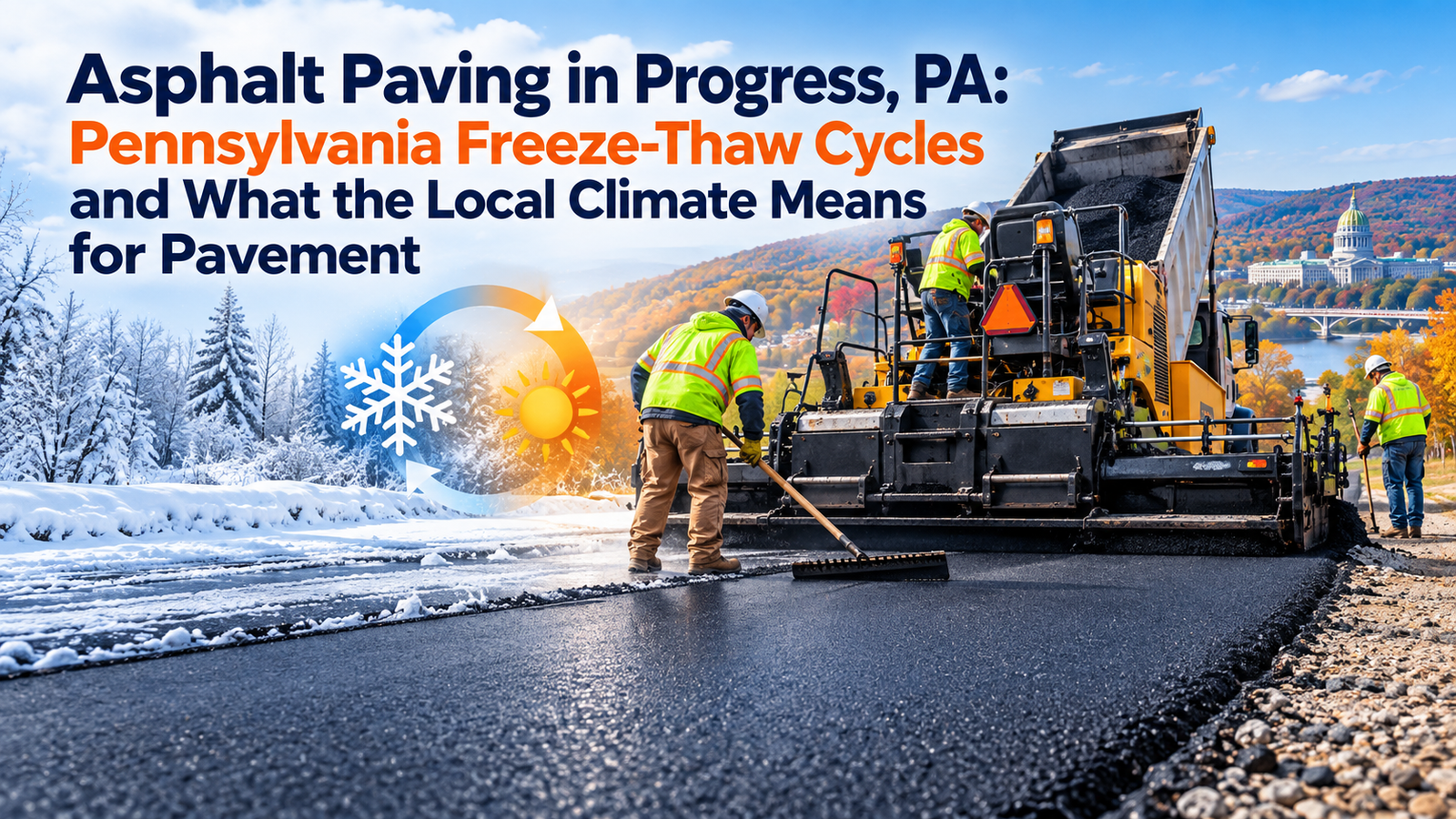
The area commonly referred to as East Harrisburg encompasses the communities along and east of the Harrisburg city line including the Borough of Penbrook, the Borough of Paxtang, and portions of Swatara Township in Dauphin County. This corridor is a dense inner-ring zone of early twentieth-century residential construction, narrow lots, aging utility infrastructure, and commercial corridors that have seen multiple cycles of development, decline, and reinvestment. The pavement challenges here are typical of mature, dense suburban communities: aging surfaces with decades of freeze-thaw exposure, root intrusion from mature street trees, drainage constraints from flat or minimally graded lots, and driveways that must work in tight spaces with limited room for equipment staging.
Understanding what Asphalt Contractor East-Harrisburg paving in this area actually requires and why the Harrisburg area’s climate makes maintenance more critical here than in warmer regions is the foundation for any discussion of pavement performance in East Harrisburg.
The Climate Factor: Why Central Pennsylvania Pavement Ages Faster
The Harrisburg metropolitan area sits at a climatic boundary point. Winters in the Cumberland and Lebanon valleys are cold enough to generate significant freeze-thaw cycling but not so cold that the ground stays frozen for extended periods. This combination repeated crossings of the 32-degree threshold rather than sustained deep freeze is more damaging to flexible asphalt pavement than prolonged cold. Every time moisture-infiltrated pavement freezes and thaws, the volume change of the water opens existing cracks slightly further. Over many cycles and many years, this process converts surface cracks into structural failures.
In East Harrisburg’s dense residential streets, the problem is compounded by aging pavement that in many cases has not received consistent maintenance over the decades. Borough streets maintained by Penbrook and Paxtang, and township roads in Swatara, have maintenance cycles constrained by limited municipal budgets. Private driveways in the area reflect the same aging process original asphalt installations from the 1970s and 1980s that have received intermittent sealcoating but no base repair or full replacement.
Soil and Subgrade Conditions in the East Harrisburg Area
The East Harrisburg corridor occupies a zone of the Great Valley geographic province where the underlying geology transitions from limestone and dolostone to shale and argillite. The residual soils derived from these parent materials are finer-grained than the soils found on the sandstone ridges to the north, with higher clay content and greater susceptibility to frost heave and shrink-swell behavior.
Clay-bearing soils in the Swatara Creek drainage area which drains much of the East Harrisburg corridor expand when wet and shrink when dry. Pavement founded on these soils without adequate aggregate base separation experiences differential settlement as the subgrade cycles through wet and dry seasons. The surface expression of this movement is a wavy or undulating pavement surface that pools water and accelerates cracking at the high and low points.
Before installation of new asphalt in East Harrisburg, a professional contractor will assess subgrade conditions, identify soft spots, and specify base repair measures to stabilize the pavement foundation. Cutting corners on subgrade preparation is the most common cause of premature pavement failure in this area.
Narrow Lots and Tight Access: The Operational Reality in Penbrook and Paxtang
The residential streets of Penbrook and Paxtang were platted in the early twentieth century, and lot widths of 30 to 40 feet are typical in the older sections. Driveways on these lots are narrow often ten to twelve feet wide and may run along one side of the lot with less than two feet of clearance between the driveway edge and the property line.
Paving in these tight spaces requires equipment sized appropriately for the work. Full-size pavers and rollers cannot operate in spaces this narrow. Mini-pavers compact asphalt paving machines designed for driveways and small lots and tandem-drum rollers in the smaller weight classes are the appropriate tools for work in these residential corridors.
Contractor staging is also constrained on narrow streets. Material delivery trucks, dump trucks hauling milled material, and the paving train itself all need street space during the work day. Professional contractors coordinate with the property owner to notify neighbors of parking restrictions in advance and plan the work schedule to minimize the duration of street obstruction.
Commercial Corridor Paving in East Harrisburg
The Derry Street and Paxton Street commercial corridors in East Harrisburg are among the busiest commercial strips in the Harrisburg area. Parking lots, access drives, and rear-lot paving in these commercial zones serve a mix of retail, medical, and service businesses. The pavement demands here differ from residential driveways: higher traffic volumes, heavier delivery vehicles, and the concentrated wheel loads of vehicles turning at access driveways accelerate pavement wear in predictable locations.
Commercial parking lots in East Harrisburg benefit from full-depth pavement design four inches of compacted asphalt over eight to ten inches of dense-graded aggregate base and from consistent maintenance that addresses cracking and drainage problems before they become subbase failures. ADA compliance requirements for accessible parking spaces, ramps, and walkways add a design dimension to commercial paving work that is absent from residential driveway projects.
Drainage: The Underappreciated Factor in East Harrisburg Pavement Performance
Drainage is the most underappreciated factor in pavement performance in East Harrisburg’s flat or gently sloping terrain. Pavement that ponds water after rainstorms or snowmelt is pavement that is being continuously infiltrated by moisture that drives freeze-thaw damage. Proper surface drainage design specifies a minimum cross-slope of two percent on paved surfaces, directing water off the surface rather than allowing it to pool.
In established neighborhoods, surface drainage can be difficult to improve because surrounding grades and curbing are fixed. A professional paving contractor identifies drainage deficiencies during the pre-project assessment and designs the new pavement profile to achieve adequate drainage within the constraints of the existing site. In some cases, this means building a slight crown into a previously flat driveway or adjusting grades at the apron to improve discharge to the street.
Alligator cracking the interconnected crack pattern that indicates subbase saturation and failure is a direct result of inadequate drainage combined with freeze-thaw cycling. When alligator cracking is present, surface treatments alone cannot restore pavement performance. Full-depth reclamation or base replacement is required.
Pavement Maintenance Programs for Property Owners in East Harrisburg
Property owners in Penbrook, Paxtang, and Swatara Township benefit from a regular maintenance schedule that addresses cracks before they develop into structural failures. The recommended maintenance cycle for the Harrisburg area crack sealing annually or biennially followed by sealcoating every three to four years is based on the local climate and the specific degradation mechanisms that affect pavement in this region.
Crack sealing should be performed in fall or spring, when pavement temperatures are in the range where cracks are at their seasonal average width. Sealing when cracks are very wide (cold weather) or very narrow (hot summer temperatures) reduces the effectiveness of the sealant by creating stress concentrations at the edges of the sealed area. Hot-pour rubberized crack sealant, applied with a heated applicator wand, is the professional standard for crack sealing in central Pennsylvania.
Frequently Asked Questions: Asphalt Paving in East Harrisburg
What causes the wavy pavement surfaces common in older East Harrisburg neighborhoods?
Clay-bearing soils in the Great Valley province shrink and swell with moisture cycles. Pavement without adequate aggregate base separation follows this movement, creating differential settlement. Proper base preparation during installation prevents this problem.
Can narrow driveways in Penbrook and Paxtang be paved with standard equipment?
Very narrow driveways require compact paving equipment mini-pavers and smaller rollers that can operate in tight spaces. A professional contractor assesses access constraints before the project begins to select the right equipment.
What is alligator cracking and what causes it?
Alligator cracking is an interconnected pattern of surface cracks that indicates subbase saturation and structural failure. It results from freeze-thaw cycling combined with inadequate drainage or subbase thickness. Surface treatments cannot repair alligator cracking base repair or full-depth replacement is required.
How often should parking lots in East Harrisburg commercial areas be sealcoated?
Every three to four years, with annual crack sealing as part of a routine maintenance program. Commercial lots with heavy delivery traffic may require more frequent evaluation and maintenance.
Why does drainage matter so much in flat East Harrisburg terrain?
Flat surfaces that pond water allow continuous moisture infiltration into pavement cracks. Freeze-thaw cycling converts this moisture into a powerful crack-widening mechanism. Proper surface crown and drainage design even small improvements in grade significantly extend pavement life.
Asphalt paving in East Harrisburg is a discipline that requires intimate knowledge of the area’s climate, soil, and operational constraints. The dense residential fabric of Penbrook and Paxtang, the commercial intensity of the Derry Street corridor, and the persistent challenge of central Pennsylvania’s freeze-thaw winters all demand pavement systems designed and maintained with those specific conditions in mind.